

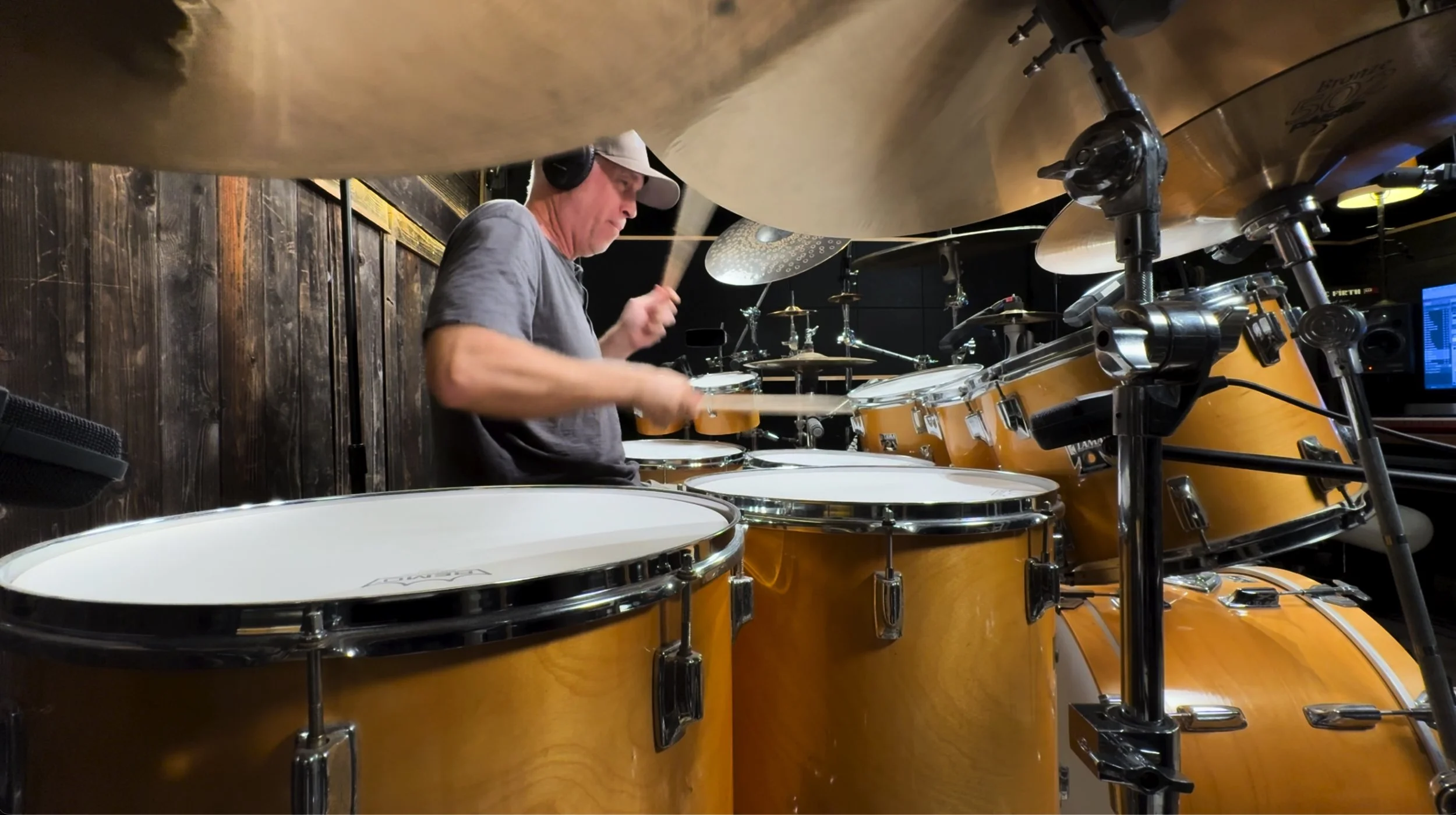
RECORDING DRUMS WITH BRAD
Learn to Record Drums Like a Professional
Start With The Free 45 Minute Course Below
It covers everything a beginner needs to know before touching a microphone, a fader, or a plugin.

Finally Sound as Good as You Play
30 in-depth video lessons. One complete system for recording professional drum tracks at home.
Drum tracks that feel small, messy, or disconnected — no matter how expensive the tools.
Most drummers and engineers spend their time in the wrong places when recording drums.
They chase mic brands before learning placement. They tweak gear before learning tuning. They worry about room treatment before understanding phase. They obsess over plugins before the recording is even solid.
And the result is always the same — drum tracks that don't do their playing justice, no matter how much money they've spent on gear.
The real secret to great drum recordings isn't better equipment. It's knowing what matters first, second, and third — and ignoring everything that doesn't move the needle.
When you understand the priorities in the right order, everything finally clicks. The kit makes sense. The room makes sense. Your mic choices make sense.
See What’s Inside
The Fundamentals of Recording Drums at Home
Here's everything covered across all 30 lessons
What's Inside — All 30 Lessons
Introduction
Introduction to the Fundamentals of Recording Drums
Components Needed for Recording & Basic Signal Flow
Chapter 1 — Setting Up Your Space
The Room
Chapter 2 — Microphones
Types & Differences
Chapter 3 — Recording Basics
Setting Up a New Session
Setting the Gain
Checking & Correcting Polarity & Phase
Introduction to Mixing: Panning & Balancing
Chapter 4 — Tuning
Tuning Overview
Tune-Bot Basics
How to Tune Snare Drums
How to Tune Toms
How to Tune Floor Toms
How to Tune Bass Drums
Tuning the Kit for a Track — Low, Medium, and High
Taming the Tone: Studio Tricks to Shape Your Drum Sound
Chapter 5 — Microphone Placement
Recording Drums with One Microphone
Recording Drums with Two Microphones
Recording Drums with Three Microphones
Recording Drums with Four Microphones
Recording Drums with Five Microphones
Recording Drums with Six Microphones
Recording Drums with Seven Microphones
Recording Drums with Eight Microphones
Overheads
Chapter 6 — Mixing Basics
The Basics of Compression
Brief Overview of Parametric, Semi-Parametric, and Passive EQ
Mixing 1: Real World Example Using Compression & EQ
Mixing 2: Glyn Johns
Mixing 3: The Wurst Mic Technique
Decoding the Mid-Side Technique
Chapter 7 — Outro
Thank You
What's Inside
How To Record A Snare Drum - All Things Considered

Introduction: How to Record a Snare Drum
Tuning
Drumheads
Snare Wires
Hoops
Mic Choice
Mic Placement / Height & Angle
Mic Placement / Simple to Complex
Setting the Gain
Phase & Polarity
Bonus: Shaping Your Snare Sound in the Mix
Every lesson builds on the last — from the drum itself to the mic, the session, and the mix.

Your Snare Drum Should Sound
Exactly the Way You Hear It in Your Head
A complete deep-dive into every element that shapes your snare sound — tuning, heads, hoops, wires, mic placement, phase, and beyond.
Most snare drum recordings don't fail because of the mic. They fail because of everything that happened before the mic went up.
The snare drum is the most listened-to, most scrutinized element in any recording. Listeners may not know why a drum track feels off — but they always feel it when the snare sounds wrong.
Most drummers treat snare recording as a mic placement problem. It isn't. It's a whole-system problem — and every element in that system affects what you capture.
The wrong head. The wrong tuning. The wrong hoop. Wires that are too tight or too loose. A mic that's half an inch off. Phase that nobody checked. Any one of these things can make a great snare sound thin, choked, or lifeless in a recording.
This course covers all of it — not just the mic placement, but every single variable that determines how your snare sounds before and after you hit record.
WHAT YOU'LL LEARN
Everything That Shapes Your Snare Sound — Covered in Full
Tuning
You'll know how to find the exact pitch and tension that brings out the best in any snare drum for any musical context.
Drumhead Selection
You'll understand how different heads affect attack, tone, and sustain — and how to choose the right one for the sound you're after.
Hoops
You'll hear and understand the sonic difference between triple flange and die cast hoops and know exactly when to use each.
Snare Wires
You'll know how wire tension, strand count, and material affect response and sensitivity — and how to adjust them to your advantage.
Mic Choice & Placement
You'll know which mic to reach for and exactly where to put it for punch, clarity, and detail.
Phase & Polarity
You'll understand one of the most common and most overlooked snare recording problems — and know how to fix it every time.
Everything You Need to Know to Record Drums at a Professional Level

Build a strong foundation for recording drums at home, then go deeper into the details that shape your snare sound. This bundle combines two full courses for big-picture workflow and precision technique.
Two full courses covering mic placement, room acoustics, gain staging, EQ, compression, and everything in between. Plus a resource hub with a beginners guide, glossary, and FAQ to support you every step of the way.

Meet Brad
With over 30 years of experience as a professional drummer, composer, and audio engineer, Brad's work has found a home on some of the world's most recognized networks — including HBO Max, TLC, Apple TV+, Discovery+, and Univision. He knows what professional drum recordings sound like because he makes them for a living — and he's spent those 30 years watching talented drummers freeze up the moment the red light comes on. Recording Drums With Brad exists to close that exact gap.
